🔞 ADULT: Post/ - Collection

Sometimes it's just all about me...

HYPED

What if the world of animal crossing was actually just a child’s vivid imagination
-
You know what’s the best? When it rains in animal crossing and real life at the same time.

Congrats Isabelle! Your brother is proud of you!
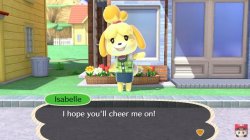
REBLOG TO CHEER HER ON
Have you ever been in the same room as a living legend? With someone that has done so much for this world and still is, by also educating others about it? Meeting with someone like that is an experience on its own. Especially when this person is a wonderful human being. Than you know how I felt last Saturday February 23rd during the lecture at the Apenheul (a Dutch zoo, specialised in taking care of different kind of monkeys and apes) in Apeldoorn. The lecture was given by none other than Jane Goodall, the research scientist and activist whose pioneering research is known all over the world. This little lady is grand in her message: everybody can make a difference to get nature and the environment back into balance. After the lecture I promised her to write a blog about it, as a donation to spread the word about her message.
Dr. Jane Goodall with Gombe chimpanzee Freud / © Michael Neugebauer
Kibale Snare Removal team
The evening started with a beautiful documentary made by Charlotte Storm van ’s Gravesande about the Kibale Snare Removal team in Uganda. This team roams the rainforest every day seeking for snare traps to remove them. Poaching is illegal in the national park, but poachers don’t honour those rules. They hunt the chimpanzees and other animals for commercial purposes. Animals that get trapped in a snare will fight it until the poachers finds them, they are released or die of their wounds. In the Kibale National Park live some chimpanzees with amputated hands or feet, because of the traps. Sometimes the men of the Snare Removal Team are accompanied by armed Rangers, but more than once they are roaming unarmed. The documentary shows in a beautiful way what the en do and go through to save the animals, and how they educate the local people about better ways to take of their environment. The job is tough, but – as the movie shows – it helps: since the start of the team less chimpanzees are maimed or killed by snare traps.
Did you know that 25% of the chimps were killed or maimed by snare traps before the arrival of the Kibale Snare Removal Team?
New ambassaor Jane Goodall Institute Netherlands
The voice over of the documentary was done by none other than Ria Bremer – a famous woman, entertainer and speaker in the Netherlands. That she did the voice over wasn’t a coincidence: Ria is since this evening the new ambassador of the Jane Goodall Institute Netherlands. Althought Ria thought the term ‘ambassador’ is rather overrated (‘Because Jane obviously is the true ambassador’), she is really honoured to be a spokesperson for the institute. ‘When I was little I was a fan of Brigitte Bardot, with her gorgeous ponytail she was a real icon,’ Ria told us. ‘There were pictures of her everywhere in my room. Until I saw a picture in a magazine of another beautiful woman with a ponytail, sitting in thought against a tree, with a chimpanzee at her side. I was so impressed that I ripped out the picture and hung it on my wall, next to Brigitte Bardot. From that moment on I was a fan of Jane Goodall.’
Did you know Jane fell in love with apes and monkeys because of the book Tarzan, king of the apes? There wasn’t only one thing she didn’t like about that story: he married the wrong Jane.
Jane Goodall: inspiration to all
The moment Jane Goodall took the stand, the whole room fell silent. Everyone at the Auditorium hung on her every word. It was impossible not to, because a living legend was talking. Jane took us during her lecture on a journey through the most important moments of her life, in which her love for nature and animal was the most important factor. The more she tells about her work, the more special it gets: she was a true pioneer for women worldwide, because as a 23 year old girl you just didn’t travel on your own and especially not to Africa. But Jane did, thanks to her mother.
Mothers & women
Mothers and women play a huge role in the stories and the life of Jane. Her mother always inspired and stimulated her to follow her dreams. She even went to Africa with Jane, so Jane could do her research. And still women and mothers are very important in the work that Jane does. ‘We educate women and girls in Africa so they can make better choices for themselves, their lives and family,’ said Jane. Mothers aren’t only important for humans, Jane discovered through her observations that chimpanzee mothers also play a big role in the development of the little baby apes. ‘The chimps that are brought up by good moms are much more socialized and willing to help others than the monkeys that are brought up by bad moms,’ Jane told us.
According to science giving names to the animals you observe isn’t very scientific. But thanks to the names Jane gave to the chimpanzees her research comes to life for every reader.
With heart, soul & intellect
Although Jane was doing research for a couple of years and thanks to the chimpanzee David Greybeard she learned a lot about the life and behaviour of chimpanzees, it became time to take the next step. To get her research acknowledged she needed a PhD. She left her home in Africa and travelled back to England to get her degree. At first the professors made a laughing stock of her research: giving names to research specimens wasn’t scientific, just like the fact that Jane stated that chimpanzees were beings like humans, with feelings and intellect. In their eyes it was impossible, because online humans had the privilege to feel and have intellect. ‘I was fortunate to find a professor who wanted to help me translate my research to science, so I could get my degree.’
Pioneering
The research of Jane was pioneering: she threw all old traditions out of the window and showed with her amazing observations that chimpanzees did have a great intellect, as well as love, friendship and other emotions. Every chimpanzee has, just like people, his or her own personality. ‘If you start looking at animals this way, than isn’t it odd that we abuse them so much?’ Jane stated.
Painting with words
Jane told the most magnificent stories during her lecture, in example about the love of brothers and how a young male adopted an orphan, pulled him in his nest at night to protect him. Or the story of Old Man who after years of abuse finds his new home in a zoo and become friends with the caretakers and how he even saves his life when he got attacked by the other chimpanzees. Her message is crystal clear: when chimpanzees can help us people, isn’t it about time that we help out the chimpanzee?
‘If a chimpanzee – an abused chimpanzee – can help a human, shouldn’t we humans be able to help the chimpanzees?’
Roots & Shoots
Jane emphasizes her message by telling that there still is time to save our planet and to save the animals on our home from extinction. Everybody can make a difference, old and young people. In example by starting a Roots & Shoots program. Jane started out with six students on her porch at her home in Gombe and it branched out to several projects of young people all over the world. ‘Everyone can start a Roots & Shoot program,’ Jane told us, ‘because the youth has the future.’ With the lecture Jane gave us a message of hope for a better future and that we all can help make it better.
‘Chimpanzees and humans are alike, but we aren’t the same. Humans have a bigger brain. How can it be that such an intellectual being destroys its own planet?’
Food for thought
Jane gave us all a lot to consider about our role on this planet, but she did so in a very gentle way. Without adding extra drama she gave her listeners an important message. A message of hope and love for the planet. What a beautiful, inspiring woman, such class and such a good friend for nature and especially the chimpanzees. I felt so honoured to be in the same room with her, can you imagine how I felt when I was able to shake her hand? Everybody can make a difference: you, me, everyone…
Do you want to know more about Jane Goodall, the Jane Goodall Institute an the Roots & Shoots programs? Surf to JaneGoodall.org or RootsAndShoots.org.
This article has been written by me and is translated from Dutch. The original article can be found on WritingBerries.blogspot.com.

