
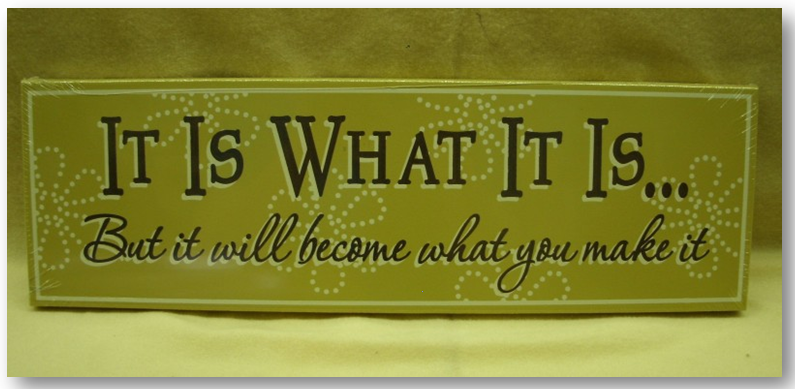
It is what it is…
I realize going into this piece that this phrase is one of the least popular collection of words around. It probably ranks in popularity with phrases like:
Your significant other saying: “I just want to be friends”
The I.R.S. saying: “We’re here to help”
And your doctor’s office calling and saying: “Your test results came in. The Doctor would like to see you in his office…” (Well, maybe not quite that bad…).
On the scale of most used phrases and most useful phrases, this ranks pretty high in DaFaDa’s household.
To most people, I think the annoyance felt upon hearing this phrase comes from their assumption that this comment is a cop out –an inability to take responsibility or have an opinion. It’s sort of like shrugging your shoulders and saying: “Whatever…” (Admittedly I hate this one).
I, on the other hand, see this completely differently. I see this phrase as a profound way of sorting out the myriad of experiences and challenges and struggles that life presents to us. I see this as a way of knowing when our efforts will make a difference, and when we are just banging our head against a wall.
There is another famous phrase that has helped me through the years that may shed some light on this type of thinking:
“God grant me the serenity to accept the things I cannot change, the courage to change the things I can, and the wisdom to know the difference.”
Or: “Lord, I know that ‘it is what it is’. Help me to know when this is true so that I don’t waste my time. But help me also Lord to know when this is not true, so that I don’t waste my life doing nothing.”
“It is what it is”, is a way of seeing that we do not have control over everything, and therefore should not waste our lives fretting over things that we cannot change. Thoughts like: “If I were only taller, if I were only a little younger, or older…, are some simple examples of things that people may fret over and for the most part have no control over.
But what about other things that may be a bit more difficult to categorize?
For example:
Two years ago, my wife was diagnosed with uterine cancer. It started out as a hunch; a little tickle in the back of her mind that told her she needed to see her doctor. Even the doctor at the time told her that her recent exam suggested that it was unlikely she needed to worry. In the end however they agreed to send her to get the appropriate testing done to make sure. Once she found out she was naturally concerned; it was the longest six months of her life. Waiting for the test results, and then waiting to do the surgery followed by more waiting for the results of the testing afterword’s before she really knew how bad it was and whether or not they got it all. After that, even though there was nothing but good news up to that point, she now had to wait for follow-ups, then concerned that something new would be found later.
In the grand scheme of “It is what it is” thinking, this is an extreme example and requires some very complex applications of this thought process.
It would have been easy in the beginning, once the news was heard, to simply throw in the towel and give up. To simply say: “It is what it is”, there is no way I can overcome something this huge in my life. If that were the case she would now still have cancer and it would be much worse than it was. This would be a good example of the wrong way to apply the “It is what it is” mentality.
During the beginning of the process, before she had the surgery, she was most definitely worried. I know in her mind as well as in life, she began preparing for whatever outcome she would face. But as we moved forward through the process she seemed to simply focus on the tasks that needed her attention and kept moving forward. She kept active and engaged in life; outwardly at least she seemed happy and in control.
It was almost as if she had decided:
“I have cancer. But we caught it early and I am doing everything I can do. I have some of the best doctors in the business lined up to take care of me. At this point, ‘it is what it is’. It’s going to work out, one way or another; in the meantime, I have things to get done… I have a life to live”.
Sometimes, especially at times like this, “It is what it is”, is a great way to say:
‘I can’t change this, but I can sure as hell learn to live with it by not allowing it to dominate my mind and bombard my emotions with negativity. Negativity leads to negative thinking, which leads to making poor choices… And poor choices tend to make a person fat… among other things.
Sometimes, it helps when I remind myself that the world is filled with elements trying to seduce me with negative thinking; why would I allow ME, to be one of those elements.
And finally; for those of you who don’t like to hear the phrase “It is what it is”, it’s important to remember that it doesn’t have to be said out loud as much as its philosophy needs to be remembered and followed when it is needed. In Fact, there are definitely times when saying this would be considered tacky and insensitive.
For example: No parent should ever outlive their children. Unfortunately, sometimes this is beyond our control. Whatever the age, whatever the circumstances, however long or short a time the child was with you the pain of such a loss is severe and all-encompassing. This is a perfect example of when it is not appropriate to say “it is what it is”. However, as time moves on and life continues, as it must, the ability to apply this philosophy in order to allow yourself to move forward and to carry on in life is crucial.
So live your life…
And don’t waste it with negative thinking; don’t allow all the things that you can’t control keep you from taking charge of what you can.
Remember that sometimes, the proper response to “It is what it is” is: “So now what do I do”?
We may not have the power to change everything in life that we don’t like, but we do have the ability to choose how we feel about it, and what we do about it once it’s done.
So the challenge then is to choose wisely. Make a choice that does not allow negative thinking to enter into the equation. After all, why would anyone knowingly allow negativity to take up residence in their life?