

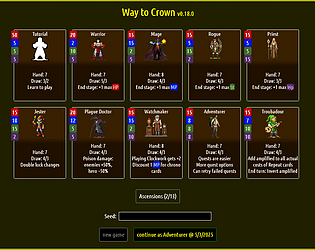
the second character once, which i find much more intuitive and fun to play
I am glad you liked Mage. Interestingly, while many players agree that Mage is fun to play, some also find him less intuitive, since Warrior is just straightforward “burst damage” character, while Mage requires player to plan across several turns and stall to regain resources right from the start.
If you have a rule for - i want this behaviour and for + i want this behaviour… for me a second word would help…
I understand your point, and indeed “perfectly additive” status like strength is best suited for going negative. However, even for more complicated cases, negative status may be simpler.
Consider the defence status. Currently it is “subtract from incoming damage, if was >0, spend amount equal to damage reduction”. Suppose I split it into “defence” and “vulnerability”, both of which work only if >0. Then the rules must additionally state:
- If both defence and vulnerability are present, smaller one is subtracted from larger one and the difference is actually applied (which is one more thing to calculate mentally).
- Cards which change the sign of statuses, like “Adapt”, must explicitly list all pairs of “opposing” statuses.
- “Defend X” for non-constant X must be re-formulated as “if X > 0, apply X defence, else apply X vulnerable”
- Cards which base their effects on defence, like Bash, need to be re-formulated to “Melee 1*(defence - vulnerability)” etc, (or rebalanced around new defence system).
Overall, the amount of text needed to explain the defence mechanics will grow. The radical solutions is, of course, just to remove “negative” statuses from the game, which many other similar games do. However, I specifically think that added depth of interactions is worth additional complexity here.
map of slay the spire is mostly there to reduce complexity and not to increase it
It is debatable, and StS map is of course a good design, with is why it is copied by most modern games. Still, consider that:
- Right from the get-go, the map offers player to plan the entire route, which is about 4-5 decisions even before the first battle.
- Possible future encounters and their relative probabilities play approximately the same role in StS and my game, but calculating probabilities is much harder in StS, since you have to account for multiple encounters at once
- Opportunities like card upgrade and removal are rarer in StS, but it makes planning for them harder. Basically, you have to decide beforehand whether you want a path allowing to upgrade a card, while in my game upgrade is always available, so the decision is simpler.
All of the above is not a negatives for StS, as it is just another level of strategy, which is simpler in my game. Naturally, beginner StS players can ignore the complications and just click on next stage randomly, but that is also true for my game.
take a look at the coming opponents (it’s good that it’s there in some sense and i only noticed recently)…
That feature is very new, was just added in latest release (see devlog). You may look at the neighbor thread on this forum for a discussion which lead to this feature.
expect the player to … read the description of every possible opponent
Probably the most jarring difference is that my game explicitly exposes the complexity which is hidden in other games. For example, experienced StS players actually do the same, the difference is that they remember all the enemies and their strengths / weaknesses either in their mind or on a separate spreadsheet (see, for example, Jorbs videos for examples of the latter).
Maybe hiding information like the possible enemy list from beginner players may help…
it feels like the process of creating it was “putting a lot of rules and cards in very fast” …
You can read devlogs to gauge development pace. Looking now myself, I see that over the last year, I introduced about 120 cards, so 10 cards per month on average. Not sure how this speed compares to other games.
a game which has more complex card rules … magic the gathering … more similar to your game.
Another keen observation on your part, MtG was indeed second-largest influence after the StS. Multi-color card cost and persistent hand between turns are most obvious MtG similarities.
Regarding your suggestion of slower unlocks: although I long resisted it, it seems like the way to go since many beginner players request it.
compared to the first version I played the warrior plays better now
Perhaps the main difference is that you are now more experienced. When I watch your video, I can see that after trying and learning certain cards and items you have already improved your play (which is the intended player progression).