

⚡ NEW: Profile/spinnylights - High Quality

Skip to main content

spinnylights

22
Posts
65
Followers
4
Following
A member registered Apr 07, 2017 · View creator page →

Creator of

Recent community posts

Thanks, I'm glad you like it! ^^ Yeah, there's a ton of niceities I'd ultimately like to add (along with a lot more areas and plot and things). I definitely wouldn't be opposed to adding a tutorial, although it might make more sense to do when the main game is mostly done and it's clearer what all the different controls will be and such. When I can actually work on this again I can try adding something like that for when you decelerate (Caelifsfan would presumably have to change his wing movements for example so you would probably feel and hear that). 

I guess I will say on the side, I've been working on a entirely new game engine from scratch (not just for this game, for any game) since there's and tons of pure coding to do on that, and it has some neat features I don't think any other engine has (certainly none I've heard of—for example it supports n-dimensional models instead of just 3-dimensional, so you can have e.g. 10-dimensional shapes in your game, and I'm working on giving it a Ruby scripting interface which I feel like is so many years overdue, among other things…). I've also been learning new mathematics (new to me at least) that help a lot with game programming. So, I've been trying to make the best of this time and at least do things that will pay dividends down the road.

aww yeah ty for making this honestly

aww ty ^^ i'm really glad, we had a lot of fun making it and i still reflect fondly on it today

(1 edit)

Maybe it's kind of silly responding to a comment from two years ago, but just in case, (a) I'm glad you like the game so much ^^ and (b) I think just about every item in the game does have some really handy applications, but it depends a lot on your build and what point in the game you're at etc., plus what sort of playstyle you're using (e.g you'll rely more on certain items if you're trying to avoid using gold). A lot of the items are useful to patch up specific gaps in your build, like as an alternative to speccing into another class and leveling it to get some skill you would otherwise want; if you're trying to level a specific character/class combo up to 8 as fast as possible, there's usually some palette of items that will help a lot with that. Sometimes they're fun for RP reasons and things too of course.

It's fixed now. Sorry about that. I lost my domain in extremely vexing circumstances.

Wow really? Amazing 0_0 I feel deeply touched honestly. A lot of the stuff in that game Lily and I came up with together, like, sitting-by-side, so I have really fond associations with it. Some of it we did more on our own, like she designed like the actual geometry of the environments for instance and of course all the 3D models and things; I did things like the code + text corpora that generates the car's thoughts, the behavior of some of the items, other random bits of code, etc. aside from the interface/car behavior (and the bundled music too I guess). The writing was both of us to varying degrees in varying places.

When we last stopped working on it there were a lot of things I still really wanted to implement that I didn't really have the math background for at the time, like a snowboarding item that would display generated "trick names" whenever you left the ground. I really wanted it to track your local axes of rotation separately so it could say things like "360°" or "1080°" appropriately and separately from "Front Flip" or other such things :P but I didn't really know how to decompose the car's transform and extract something like that. Now I do ^^ so I could go back and finish that item.
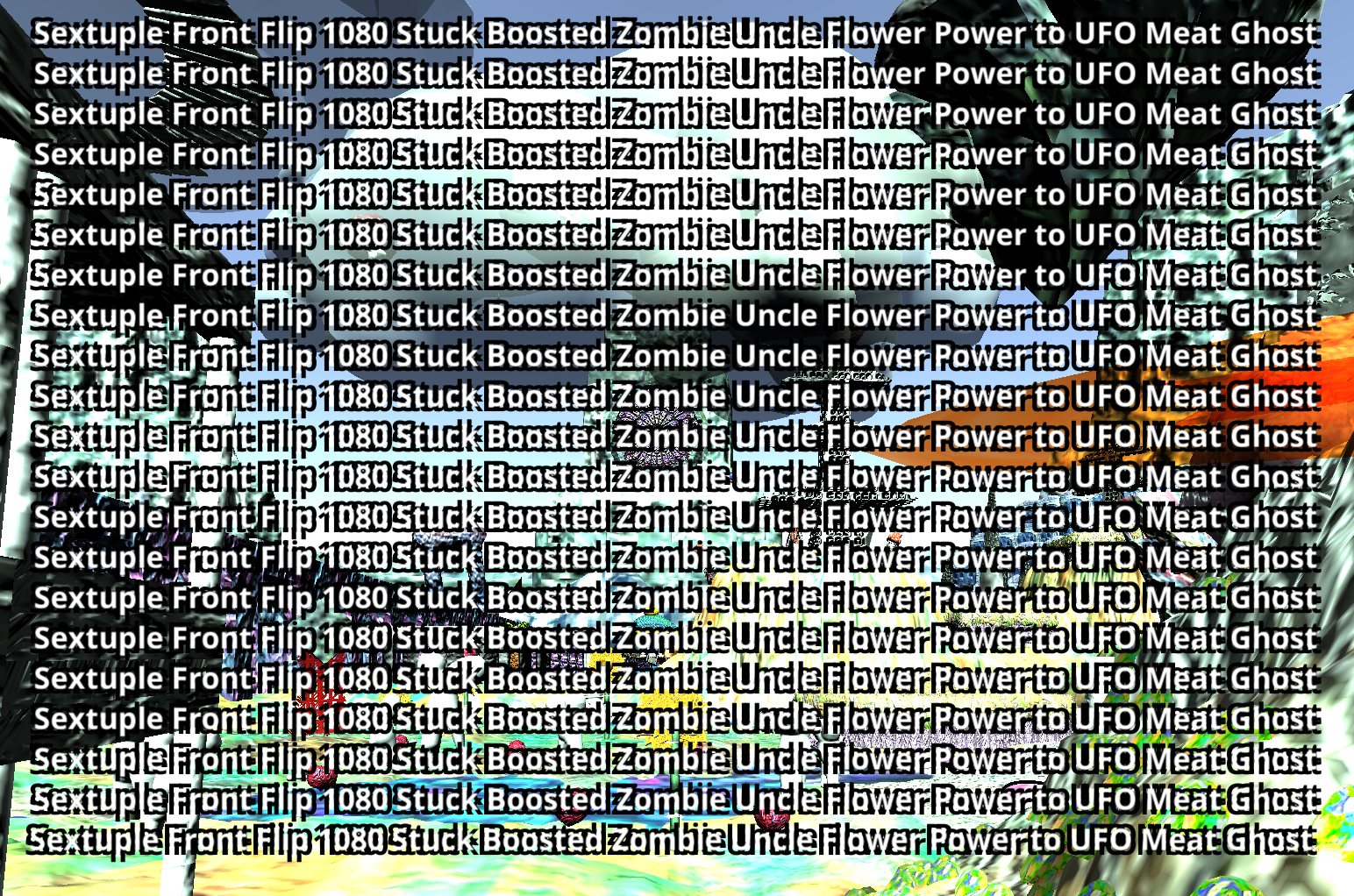

I also wanted to add a pinball machine in the sky you could drop the car into and then have the camera zoom out and fix on the pinbal machine and have the controls change so that you can play pinball with the car as long as you can keep it in the machine. I wasn't sure how to make that work either and I'm pretty sure I do now. etc. I also want to add a ton of speakers in the world playing short music loops you can pick up and carry around with you and have them sync up with each other if you want and things, and I've gotten faster at making short loops recently so it seems more feasible than it did to me back then. Lily and I talk kind of often about going back to work on it. It's nice to hear that there's someone out there who likes it that much ^^ makes me want to make it more of a priority.

By the way I'm almost done with updates ;^^ they've been something of a project because I went like three months without running them which is way too long. I think they're basically done now though aside from some housekeeping and things. (I feel obligated to note that Linux on the desktop isn't always this involved to maintain, just Gentoo specifically. ;^^ ) I'll let you know what happens once it's all totally done.

(1 edit)

Awww thank you, I'm glad you enjoyed it! ^^ Given your experience with the perspective/control scheme you might be interested to know that I was also the one who designed and programmed the controls for The Last Car. :P I'm glad you enjoyed the ambiance of just flying around in it and doing random stuff, that's a lot of the fun of it for me personally right now :P

Oh by the way, if you didn't see a red glyph appear when you interacted with the octopus, v0.12 has a fix.

Okay, if you download v0.12, all you should have to do is press <Esc> to open the config menu and then click the "AZERTY" button to remap the controls, and it should remember your choice on future runs of the game. Let me know if you run into any problems.

True! Yeah, the keybindings are hardcoded for QWERTY and assume that you'll use the mouse with your right hand—I was trying to pick my battles during the jam and setting up UI stuff (plus infrastructure to pause the game while the menu is up and things) can take time, so I just went with what I thought was probably the most common setup. It should definitely have input config ultimately though. I've been seriously considering porting it from Godot to my own nascent engine as my next step, which is why I haven't done anything like that post-jam yet, but I don't think input config would take too long to get going so if that's something you need I'll go ahead and do that in Godot and put up a new build you can use.

Sorry it took me a few days to get back to you about this. I started playing Dogman 95 when I first received your reply here, but I got a migraine partway through and had to stop, and I've just now returned to finish it. Anyway, it worked totally fine, so I really wonder what's going on. I'm working on doing system updates right now because I'm well overdo for them, and once they finish I'll try again and see if the problem persists, in case it's due to some obscure regression in something on my system that's since been fixed. (They take a long time to do in Gentoo because you have to compile like 1600 packages from source, at least for a typical desktop/workstation environment. ;^^ )

Adorable and one of the silliest games I've ever played XD Kind of makes me think of Stephen (thecatamites)'s early work like Paul Moose or Rip van Bubsy in a very nice way, although obviously it's got its own thing too. I loved how even though you have a big fancy suit of armor and stuff you just run around and bark at things like a regular dog. Excellent gameplay BARK!/BARK!

Oh this is the most eloquent phrasing of something ive been railing against for years!

Aww thank you so much, that's really sweet of you to say and I'm chuffed to know you feel similarly!

I moved into games in my 30s and was baffled at how most of the communities are comprised of aspiring business gurus working on games as if they are any other interchangable product, looking for a target for their entrepreneurial skillset, or by industry realists who, by seeing one too many Ten things your game must have lists, no longer remember there’s any other way. I still dont get why they're so suceptable
I'm not entirely sure myself, but I think it probably does have something to do with the time in which they originated, at least as far as things over here in the U.S. go. Like, I think of the commercialization of games as really getting going here circa 1980 or so, with e.g. Wizardry pioneering the expensive-prestige-game-in-a-fancy-box model and the like (what there was of game dev culture prior to that was often quite different in tenor I think and adorably so, e.g. https://archive.org/details/Whattodoafteryouhitreturn). That was also a time when the commercialization of personal computers themselves was picking up steam, and the prevailing attitudes I've encountered in source material from then (e.g. magazines, newspapers) about both PCs and computer games has a lot of the same mix of wide-eyed we'll-be-so-rich Silicon-Valley-itis and hard-edged "think of our market research, this is business" kind of attitudes that you're describing today.

It probably also doesn't help that when they got a huge boost in popularity in the '90s as the price of hardware came down, even though there was a burst of experimental activity in the early-mid '90s with the "multimedia CD-ROM" etc., the popular view of them I remember from that time was that they were mostly shallow entertainment for children and maybe the odd "computer geek" here and there, so I think a lot of the experimental work done in games then went mostly unacknowledged by people who were involved in preexisting artistic undergrounds (with a few exceptions like the Residents and William Burroughs etc.), and that particular strain mostly faded away by the late '90s/early 2000s. As a result, I think a culture coalesced around games where there's like, a thriving commercial industry, a small academic scene that's mostly neglected by the mainstream culture, and little real underground or avant-garde to speak of, something we still live with more-or-less today. It's kind of sad to me that in this society, this maybe suggests that it's basically guaranteed that if an art form is popular, it will have a commercial industry with a size in proportion to the form's popularity, people will make sure of that, but whether or not it develops a thriving underground or an academic scene are both kind of left to historical accident. It's a little harder for me to speak to locales outside the U.S. in that regard but the situation in other countries where games are popular seems broadly similar.

One thing that does seem really strange to me about games though is that it's not as if they don't have some sort of organic life outside of the mainstream commercial industry and academia—obviously tons of people of all ages make their own games and have since the form began—but even in the smallest-scale settings, people largely seem to follow the mores and aesthetic standards set down by the commercial industry. That seems so strange to me (as I guess I discussed in that essay) because the ways the large commercial studios tend to make artistic decisions are greatly constrained by their market positions and the pressures on them as for-profit businesses. The proverbial bedroom developer has no need to worry about things like that—they're free to just go for whatever they think would have the greatest artistic effect in their eyes, or even just whatever pleases them casually in the moment or w/e—but for some reason so many people even just working as hobbyists seem to be able to envision their own success only in the style of commercial studios. It seems really hard for many of them to be able to just think like, "If I love the game I made, it was a success," or, "If I make a game unlike any that game before, it will be a success whether or not the game is 'good' or 'bad'," or anything else along these lines—instead they think of making the front page of Steam and getting high marks in major industry mags and stuff, presumably followed by an influx of investor cash for the next game that would pressure it even more strongly to prioritize profit above all else.

As a musician, I've run into people who also have an attitude like this in music—like, who hope to get signed to major labels and kind of design their whole act around that, and even go to marketing workshops for musicians and conferences and stuff. But like, with all the bands I've ever been in, we've always had an attitude like, "I guess if we start making a lot of money for some reason we'll figure out what to do about that then," and otherwise our questions have always been more about the music directly and our stage act and stuff more just in themselves. I don't feel like it's especially hard to find musicians like that, even among professionals; I think a lot of both musicians and "music fans" tend to feel even that it's rather gauche to approach music with a marketing mentality, that it tends to make tasteless, forgettable music without much original character etc., so that you should avoid thinking that way even if you do depend on your music for your income.

Although I can see in terms of the historical trajectory how games have tended to avoid having developers like this (with some exceptions of course), I'm perpetually confused every year why it stays that way even though I feel like all the ingredients are there for a healthy underground aside from people's mentalities (widely accessible cheap-to-free equipment and tools, easy means of independent distribution, an art form with a lot of folk enthusiasm behind it, etc.). The closest I think I've seen one to coming together firsthand was when I initially got "seriously" involved in game development in the early 2010s with the scene around Glorious Trainwrecks and freeindiegam.es and so on; however that world has mostly been blown to the wind by now having made an unclear impact on the larger gaming culture, like the "multimedia CD-ROM" era before it, with the mainstream culture mostly seeming to have shrugged the challenge to it off by just commercializing indie games more aggressively in that case. Maybe the dynamics operate on 20-year cycles and the early 2030s will also see a burst of experimental activity in games followed by another long lull. I wish I knew what it would take to make it more of a consistent thing than that though.

the virulent commercialisation of games breaks my heart daily, ill join you in the bunker

Hurra hurra!

Let me know when you upload it to the new site  ❤️

Will do ^^

I'm very curious about this, as a Metal Gear fiend with a special fondness for the 2D MSX games as well as an occasional crossword dabbler. However the graphics don't seem to work on my system (Gentoo Linux with vanilla kernel v4.3.16 and nvidia drivers v565.77, tried running in Wine v9.22, staging and vanilla, and Firefox v134.0.1). If I flail around randomly on the keyboard I hear typing noises sometimes and ominous sneaky music and things but the screen is just pure black. It's possible I'm just missing something of course. :P

(1 edit)

oh good point! thanks for bringing this to my attention! i guess like, in the short term thankfully it's on Archive: https://web.archive.org/web/20240921233007/https://www.milky.flowers/writing/let... but i really should get this up on my new site (i lost that domain after having it for like ten years -_- my website's now at https://spinnylights.net but there's still barely anything on it, i haven't gotten the old milky.flowers stuff up yet let alone my new work…i have like half of a redesign finished on my local pc, it was what i was working on before i decided to participate in that jam :P but anyway i'll try to prioritize getting this back online because i had forgotten that there's a link to it here ;^^ )

The Animals Unfettered [trailer]

Yeah, sorry about that—I had to do this in such a short amount of time that I didn't really get a chance to make it more elegantly portable. I honestly think it might make a nice web application, looking at it now, so maybe I'll add that to my website down the road.

(4 edits)

(hi zoe here ;P) just to give a little extra technical detail or whatnot, the essential idea is that you slow the player as they approach some sort of central point, so that they approach it kind of asymptotically. it's convenient to place this point at the origin (0,0,0) so we did that in this case.

also, we measured the player's distance from the origin "floorwise" (ignoring height) because we put them on a fixed track on the height axis: at the start of the game we imagine a straight line between the player's starting position and the origin, spin that around into a cone with its tip at the origin, and set the player's height along that cone based on their distance from the origin. this trick allowed Lily to arrange the geometry in a more "choreographed" fashion since it allows you to predict how high up the player will be at any point.

also, as a little final touch, it felt right to me to narrow the player's field of view somewhat as they approach the origin (specifically we had it approach half of its starting value, which we figured out by feel). i reasoned that if you were actually shrinking to a smaller size but otherwise staying the same shape, your eyes would move closer together which i think would slightly narrow your field of view. (of course if you turned into a mouse or something your field of view would actually increase…but that's another topic…)

anyway, here's a step-by-step description of how the whole technique works in this game:

  1. Arrange the 3D space so that the origin (0,0,0) is wherever you want to zoom in furthest. The basic idea is that we'll slow player's movement speed more and more as they approach this point. You can cluster geometry very tightly in that area when you're placing your models because they'll glide through it at a quite leisurely pace.
  2. Pick somewhere you want the player to start. When they start out, we'll have them move at the normal speed, and move faster as they move away from the origin from the start, and slower as they move towards the origin from the start. We'll also set their height based on their starting point and their radial distance from the origin.
  3. We can calculate a few values at scene load time to save work in the main loop. These are:
    1. H₀, the player's starting height, which in Unity is their Y-axis position,
    2. D₀, the player's "floorwise" distance from the origin, which in Unity is the magnitude of the player's XZ position vector,
    3. r = -H₀/D₀,
    4. M₀, the player's starting movement speed, and
    5. F₀, the player's starting field of view.
  4. Each frame, we:
    1. calculate Dᵢ, the player's current "floorwise" distance from the origin, i.e. the current magnitude of the player's XZ position vector,
    2. calculate d = Dᵢ / D₀, the ratio of the player's current distance to their starting distance,
    3. set the player's movement speed to Md,
    4. set the player's height to (Dᵢ - 2D₀)r + H₀, and
    5. set the player's field of view to F(d + 1)/2.

as she alluded to the code Lily posted is messier than this description since it's basically in the state we left it in after playing around it with it for a while and deciding we were happy with it. if you'd like a tighter code sample following this description i don't think it would be much trouble for me to write.

anyway, for other ideas branching off of this, in theory you could have mutiple focal points and set the player's speed based on their distance to all of them; the math would be a little thornier but the basic idea could stay the same. also, regarding range of motion, you could measure the player's distance from the origin on all three axes and let them move noclip style for a more "open world" approach, or you could have them move only on one axis which would make the game into a sort of endless tunnel. i think you could also have an interesting "4D" approach where you transform all the geometry based on the player's rotation around the origin.

(3 edits)

psssst…over here…i got somethin' for ya if that's a bother

EDIT: the above link now points to version 2 of the guide which is much more comprehensive than the first version and also includes a more proper tutorial; if you still want version 1 for some reason it's here

also if anyone wants to see a high-res version of the "glossy card" part of the start screen, here's that as well

EDIT 6/24/25: i fixed the above links. note that the guide is a little stale now because more things have been added to the game—it's still broadly useful, just no longer as comprehensive. i have plans for a v3 but lily and i are actually planning out a lot of new stuff to add to the game rn so i might wait until there's a lull in development or something.

If anyone wants to play this in Linux, I had good luck using a fresh 32-bit Wine prefix.

speaking as someone close to the author it's 100% sincere, just a celebration of the life of duimpbsy