
What Bad Writing Looks Like … and How to Fix It [With Detailed Examples]
This post was first published in March 2021 and most recently updated in June 2024.
A lot of writers worry that they may not be good enough to be successful.
The truth is that however “good” or “bad” your writing is, you can improve with practice and with careful self-editing.
But how do you know if a particular piece of writing is any good? Once you get beyond the really obvious things, like spelling mistakes and grammatical errors, what exactly does “bad” writing look like? More importantly, how do you fix it?
That’s what we’re going to tackle here.
Is There Even Such a Thing As “Good” Writing?
Over many years of reading and writing, I’ve heard two different schools of thought about “good” writing.
“Lots of Popular Books Are Really Badly Written”
Some people, particularly journalists and literary critics, can be very judgemental about popular books. The Twilight series, Dan Brown’s books, and Fifty Shades of Grey are ones that have come in for particular criticism.
These books might not be “good” in a literary sense – they’re unlikely to go down in history as great works of art – but they certainly do well commercially. Plenty of people enjoy them as entertainment or escapism.
There is nothing wrong with this.
Personally, I enjoy a lot of books that are considered literary fiction or classics – I studied English Literature as an undergraduate. But I also enjoy plenty of genre and commercial fiction, and I’ve read my share of fanfiction too. I’ve enjoyed all of it, in different ways.
Please don’t think that your writing is bad because it’s not literary, even if the people around you (in your family, your friendship group, or at school or university) only prize literary fiction.
“There’s No Such Thing as Good or Bad Writing”
At the opposite end of the spectrum, some people think there’s really no such thing as good or bad writing, only writing that’s inappropriate for its context.
For instance, a very clear, straightforward style might be right for a software tutorial but not for a literary novel. Rhyming verse might be perfect for a children’s book but not a romance novella.
However, some writing simply is bad, because it wouldn’t work well in any context.
Of course, this doesn’t mean it’s irredeemably bad. A poorly written first draft could, after some editing, become a really strong finished piece. My own rough drafts are stuffed full of clunky sentences, inconsistent characterisation, unintentional repetition, and plenty of other kinds of poor writing. And that’s okay! What matters when you’re at this stage is simply finishing that first draft, not perfecting every word.
This type of “bad writing” is what we’re going to be looking at today: first or early draft writing that still needs quite a bit of work before a reader can enjoy it.
Get My (Free!) Editing Checklist to Help Improve Your Writing
Want a free checklist of writing mistakes … and examples of exactly how to fix them? You can get the “Quick Reference” guide from Editing Essentials for free by popping your email address in below.
You’ll also get writing & editing tips straight to your inbox through my free newsletter. (Unsubscribe at any time.)
Here’s What Bad Writing Looks Like
Here’s a passage of bad writing that I’ve created, based on a lot of common drafting mistakes. I’ll split it into three parts, and go through the mistakes (and how to fix them) after each.
Important: If you find yourself recognising some of these mistakes from your own work, please don’t think that you’re a bad writer! There’ll be plenty of things that you’re doing really well too.
Bad Writing Example #1
“Hi James,” announced Jason, spotting him in the street. “It’s a while since I’ve seen you.”
“Hi Jason,” exclaimed James with surprise. “You’re right. I haven’t seen you since Dave’s party. How are you?”
“I’m fine, thank you,” smiled Jason. “How about you?”
“I’m great, thanks,” James laughed. “In fact, I was just about to go and get a coffee. Do you want to come with me?”
“That sounds good, thanks James. I’d love to catch up.” Jason looked around the street where lots of people were walking back and forth. He wasn’t sure where the nearest coffee shop was but perhaps his friend knew. His old confidence had lived here for years. Jason was just visiting the town because he had been picking up his new glasses from the opticians.
“Where should we go for coffee?” Jason queried, waving his hand around to indicate that he was uncertain of the direction in which to go.
“I know a great place,” James explained. “Just follow me.”
Let’s look at some of the positives of this short piece first. There’s always something good in any piece of writing.
For instance, the dialogue is correctly punctuated. Theres’s also a fairly good mix of dialogue and action. There are rather a lot of dialogue tags though there is an action beat used in one instance (“Jason looked around the street”) as a good alternative to a dialogue tag.
Unfortunately, there are quite a few things that aren’t working well here. Let’s go through them one by one.
Overly Similar Names
Are you getting confused between Jason, the newcomer to town, and James, the friend who lives in the town? It’s a good idea to avoid having two characters with names starting with the same letter, especially if those names are (a) roughly the same length and/or (b) the same gender. A Jason and a Jennifer wouldn’t be nearly so confusing. I’m going to rename James as Dave in the next extract, because I’m getting so muddled myself!
Poor Dialogue Tags
Words like announced, exclaimed, smiled, laughed, queried, and explained draw attention to themselves – rather than to the actual dialogue. They sound like the author is trying too hard. The words “said” and “asked” would work fine instead. In particular, I’d avoid tags that are particularly unusual (like “queried”) and ones that are an action rather than a way of saying something (like “smiled” and “laughed”).
Using the Wrong Word
The word “confidence” (in “his old confidence”) should be confidant (someone trusted and confided in). This sort of mistake is really easy to make, especially as sometimes auto-correct may change a correct but unusual word into an incorrect but more familiar one. It’s an easy thing to fix, but definitely something to watch out for when editing.
Potentially Confusing Phrasing
We’re told that “lots of people were walking back and forth” in the street. This seems to imply that the same people are walking one way then back the other, which is unlikely to be the case.
Irrelevant Details
The information about people walking in the street is hardly worth mentioning: we’d expect it (unless the scene is set very early or late in the day, when a crowded street would be more unusual and worth mentioning).
Over-Explaining by the Author
Jason asks where the coffee shop is, waves his hand around, then the author explains why he waves his hand around (“to indicate that he was uncertain of the direction in which to go”). The reader likely doesn’t need the gesture explained. Even if they didn’t understand it, they’d get it from the dialogue.
Bad Writing Example #2
(I’ve now renamed James, who lives in the town, as Dave. That way, the character names aren’t so easy to muddle up.)
Dave and Jason quickly walked down the street. Dave was wearing a black coat and a blue hat that he thought looked warm. It was a windy day and Jason was feeling a little bit cold.
The tall man led him down the road and past some shops and then they crossed over the street at some traffic lights where the cars stopped obediently for them to cross at their leisure though Dave quickly strode across with long steps. Jason remembered how his former comrade had always won the 100 meter sprint at school, over 30 years ago. He wondered whether he too had happy memories of their days at school. For Jason, they had truly been some of the best days of his life. He could have gone to the reunion a few months ago but he had decided not to in the end because he was going on holiday with his sister and her kids, his niece and nephew, who were aged three and five years.
Again, there are some positive things here. There’s a growing sense of the relationship between the characters, with a sense that Jason admires Dave (with his recollection about the school days). We also get a bit more of Jason’s backstory, with a mention of holidaying with his sister and her kids – though this does seem like it’s been forced in a bit.
Here’s what’s not working:
Confusing Use of Pronouns
If you have two (or more) characters of the same gender in the same scene, you need to pay careful attention to pronouns. Here, the sentence “Dave was wearing a black coat and a blue hat that he thought looked warm” is confusing because the “he” seems like it would refer to Dave – but it’s actually referring to Jason, who’s looking at Dave.
Using Phrases Instead of Character Names
Like coming up with lots of alternatives for the perfectly good word “said”, using phrases instead of character names is a common mistake. Again, it’s a problem because it draws attention to the wrong thing: the strange phrase, rather than the action or dialogue taking place. Here, Dave is referred to as the tall man and [Jason’s] former comrade. It would be better to simply use his name.
Unintentional Repetition
Within a single sentence here, we have the words “crossed”, “cross” and “across”. While they’re not all the exact same word, they’re so similar that they start to jar a bit on the reader. Repetition is a powerful tool in writing, but unintended repetition will catch the reader’s attention and break them out of the world of your story. They’ll start wondering why you’re so very fond of a particular word (or its close variations).
Overly Long Paragraph
The second paragraph in this section is quite long. Its length might be normal and unexceptional in some types of fiction (e.g. literary or historical fiction). But compared with the other paragraphs in this passage, it seems a bit on the long side.
Too Much Irrelevant Information
As well as being rather long, that paragraph seems to contain a lot of information that isn’t particularly relevant. Some of this is stating the obvious (the cars “stopped obediently” at the traffic lights – which is exactly what you’d expect them to do) and some seems like a tangent from the scene (Jason’s memories about school and the fact that he didn’t go to the reunion). It’s possible that this information is important to the plot, but if so, it could be woven into the story more naturally.
Redundant Phrasing
We’re told that “Jason quickly strode across with long steps.” Just “Jason strode across” would convey the same meaning, without bogging down the action with unnecessary words.
Bad Writing Example #3
At long last Dave shouted “Here we are!” and they went into the coffee shop. There was a display of cakes and biscuits behind a glass panel at the counter. Jason thought about getting one of these rich tempting delights. But he was trying to cut back on sugar so he decided to give it a miss.
“Shall I buy the coffees, Jason?” enquired his friend.
“Thank you, Dave. That’s very kind of you. But I insist that I buy them,” Jason insisted.
“Definitely not,” exclaimed Dave, wanting to pay as Jason was visiting his town. “It’s my treat.”
After a short period of deliberation, they decided to each have a latte. They stood and waited patiently for the barista making the coffees and to bring them over. Dave paid with a ten pound note, as he wanted some change, and put his change in his right trouser pocket. Once the coffees were ready, Jason and his former schoolmate went to find an unoccupied table at the back of the cafe.
Again, the dialogue is well punctuated and laid out, albeit with some rather attention-seeking dialogue tags.
But once again, there’s quite a bit of editing needed.
Here are some of the most obvious problems:
Blow by Blow Description of Mundane Event
Dave and Jason go into what we can only assume is a fairly conventional coffee shop, order lattes, and sit down. This is, quite frankly, boring writing. The scene doesn’t need to be described in minute detail (with a fairly pointless back-and-forth conversation, the details about Dave paying and where he puts the change, and so on).
Detailed Description of What a Character DOESN’T Do
Jason looks at the cakes and biscuits but decides not to get one. Unless him cutting back on sugar is particularly important to the plot or his character arc, we could skip this entirely. Otherwise, something like “Jason resisted the temptation of the cake display” would tell us all we need to know. One of the great things about the novel form is the ability to dig into a character’s thoughts … but only when those thoughts are actually interesting.
Chit-Chat Dialogue
This has been a problem throughout the whole passage. Dave and Jason chat but without saying anything of meaning. This happens a lot in life – but it shouldn’t happen in your story! Unless the characters are about to have a row over who pays for the coffees, we don’t need the back-and-forth that happens here.
Stilted Dialogue
As well as being a bit chit-chatty, the dialogue is oddly stilted. The characters use one another’s names (which people don’t tend to do when there’s only two of them, as it’s obvious who they’re addressing) and the language like “that’s very kind of you” seems strangely formal.
Wavering Point of View
We’re told that Dave wanted to pay because Jason is visiting his town, and that he paid with a £10 note because he “wanted some change”. The rest of the passage has been from Jason’s point of view. Dipping into what Dave wants comes across as head-hopping.
In the whole passage, almost nothing has happened. Two old friends meet unexpectedly and decide to go for a coffee. There’s no conflict or tension. It needs to be a lot shorter, better paced, and with an eye to intriguing the reader with things like unanswered questions.
Turning Bad Writing Into Good Writing
As I said earlier, no writing is irredeemably bad … and everything you write can be (and probably should be!) redrafted.
As part of the rewrite, I’m going to assume that there are some key details we need to keep because they’ll become relevant to the plot later:
- Dave is wearing a hat
- Dave regularly won the 100 meter sprint at school
- Jason is in an area where he doesn’t live
- Jason didn’t attend the school reunion
I’m also going to keep the key plot events: the characters meet and they go to a coffee shop to talk further.
“Hi Jason!”
It was Dave – Jason hadn’t seen him in years, and had forgotten he even lived around here. “Dave! It’s been a while.”
Dave smiled. “Got time for a coffee? I know a place just up the road.”
They strode down the street, Jason regretting that he hadn’t dressed more warmly, and feeling a little envious of Dave’s woolly hat. He had to half-run to keep up with Dave – but then, Dave had always been fast, winning the 100 meter sprint every year at school.
“Did you go to the reunion?” Jason asked.
“Nah, mate, did you?”
“Nope,” Jason said. “I was on holiday with my sister and her kids.”
They walked into the shop, Linda’s Coffee. Dave said, “What do you want? My treat.”
“Oh, thanks. A latte, please.”
It was a small cafe, without the glossy sheen of the chain coffee shops. It was deserted, too. The only other person there – presumably, Linda – handed them two generous lattes.
Dave and Jason settled in battered leather armchairs.
“So what brings you to this part of town?” Dave asked.
I wouldn’t claim this is the best piece of fiction I’ve ever written … but hopefully you can see it’s a huge improvement on the original. It gets through the required information fairly quickly, and perhaps starts to raise a few questions, like why Jason is in this part of town, why Dave didn’t go to the reunion, and what the relevance of Dave’s speed might be.
How to Improve Your Own Writing
If you’ve written a whole draft, whether that’s of a short story or a novel, then that’s a great achievement!
Please don’t worry about your writing being “good enough” at that stage. You’ve got plenty of time to rewrite, to keep what’s working, and to cut out writing that was essentially you warming up to get into a scene.
In your own work, look out for any issues like the ones we’ve gone through here. You might also want to check out these lists of common mistakes (plus examples) for some more help:
- Ten Book-Level Mistakes to Watch Out for When Redrafting Your Fiction
- Ten Sentence-Level Mistakes to Watch Out for When Editing Your Fiction
Another great way to improve is to ask a writer friend (or a beta reader) to give you feedback on your own writing. I know this can be really daunting, but good feedback will help you pin-point what you’re already doing well (and can build on) as well as highlighting areas where you may need to spend time editing.
As a general rule, I’d aim to have a solid draft before seeking feedback. That way, you can make the most of your friend or beta reader’s time, as they won’t just be pointing out problems that you already knew about.
Get My Free Editing Checklist (Plus Editing Essentials Discount)
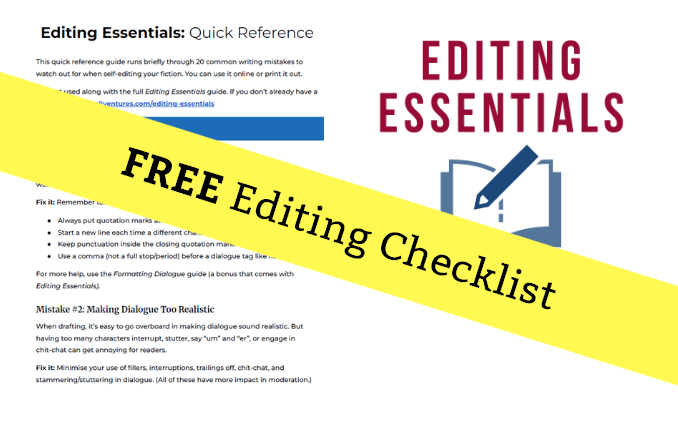
To join the Aliventures newsletter and get my free editing checklist, covering all these kinds of mistakes and more, pop your email address in below:
When you sign up, you’ll also get a discount code for Editing Essentials, my full guide to editing that the checklist is based on. It’s packed with examples and comes with a bonus guide to punctuating and setting out dialogue correctly.
About

I’m Ali Luke, and I live in Leeds in the UK with my husband and two children.
Aliventures is where I help you master the art, craft and business of writing.
Start Here
If you're new, welcome! These posts are good ones to start with:
Can You Call Yourself a “Writer” if You’re Not Currently Writing?
The Three Stages of Editing (and Nine Handy Do-it-Yourself Tips)
My Novels
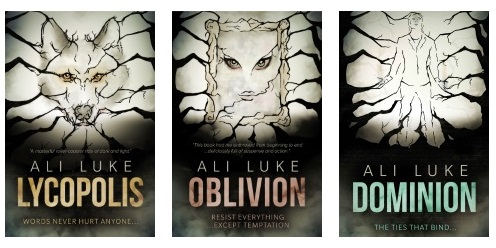
My contemporary fantasy trilogy is available from Amazon. The books follow on from one another, so read Lycopolis first.
You can buy them all from Amazon, or read them FREE in Kindle Unlimited.
I guess this article is meant for me…
im absolutely RATTLED over reading this and realizing why i dont like so much of my writing is because i do the whole ‘blow-by-blow of a mundane event’ section. this…this is gonna change me
It’s a really easy trap to fall into as a writer! I’m really glad this was helpful. Keep writing (and don’t forget to pay attention to the bits you DO like in your own writing … see what they have in common and how you can do more of that stuff). 🙂
Oh, wow…remember my first ever comment on your blog? “I want to be good, but I know I’m not. Is there any hope for a writer like me?”
It’s quite gratifying to see that I immediately recognized most of the mistakes in these passages (and I predicted you’d mention that there was no tension, nothing was really “happening”). And a lot of these mistakes are ones I don’t think I tend to make. (Though it’s quite possible I’m making OTHER ones! XD)
Emma’s last blog post ..What is the Cosmological Principle?
Hey, I’m not surprised you spotted loads of the mistakes here, because you’re a GREAT writer! And we all make mistakes. I make plenty! That’s what all the rounds of edits (and beta-readers / editors…) are for. 😀
And yet … her ‘correction’, while an improvement, ain’t that great either. Too many people out there pretending to have the skillset to teach others what to do — when they quite simply don’t! Especially when it comes to the arts.
As I said in the post, I’m hardly claiming it’s the best fiction I’ve ever written … I’m glad you agree it’s an improvement on the “bad” version though. 🙂
Feel free to share in the comments how you’d rewrite it!