
For years, our industry has debated (and sometimes derided) the concept of the "UX unicorn,” that mythical professional who can do it all: qualitative research, quantitative research, design, content strategy, and more. Over the past decade, we've concluded that specialization is more practical, especially as larger design organizations and focused roles became the norm. As AI reshapes our field, we're seeing an interesting shift: the return of the generalist.
The Era of Specialization
In the past decade or two, UX has been highly specialized in large organizations with higher UX maturity. These organizations have typically employed:
- Dedicated method-specific researchers
- Interaction (or UX) designers
- Content strategists
- Visual designers
This specialization makes sense — each area requires deep expertise and specific tools, and in large organizations, there’s been a high enough volume of work to justify employing a separate role. When structured correctly, these separate roles collaborate, bringing their specialized skills together to create well-rounded, vetted solutions.
AI's Impact on Specialized Skills
AI is already shifting this dynamic. AI tools and capabilities are starting to fill skill gaps, assisting in specialized tasks that once required years of expertise to master.
For example, a visual designer can now leverage AI to generate various options for interface copy. A researcher can get AI advice on an accessible color palette or explore different data visualizations.
This democratization of expertise is happening gradually across both UX tools and roles. Increasingly, individuals can accomplish tasks that previously required collaboration with several experts in different areas. As genAI technology becomes more reliable and better integrated into UX work, this trend will accelerate.
This trend won’t end professions altogether, though. While AI increasingly complements human abilities, current large language models (LLMs) still require careful human oversight due to hallucinations and context drifting. Trained professionals will be necessary to catch errors, align AI outputs with real-world constraints, and coordinate across teams.
The New Era of Broadened Expertise
The rise of AI tools doesn't mean becoming a "unicorn" who can do everything perfectly. Specialization will remain valuable in our field: there will still be dedicated researchers, content strategists, and designers.
However, AI is broadening the scope of what any individual can accomplish, regardless of their specific expertise.
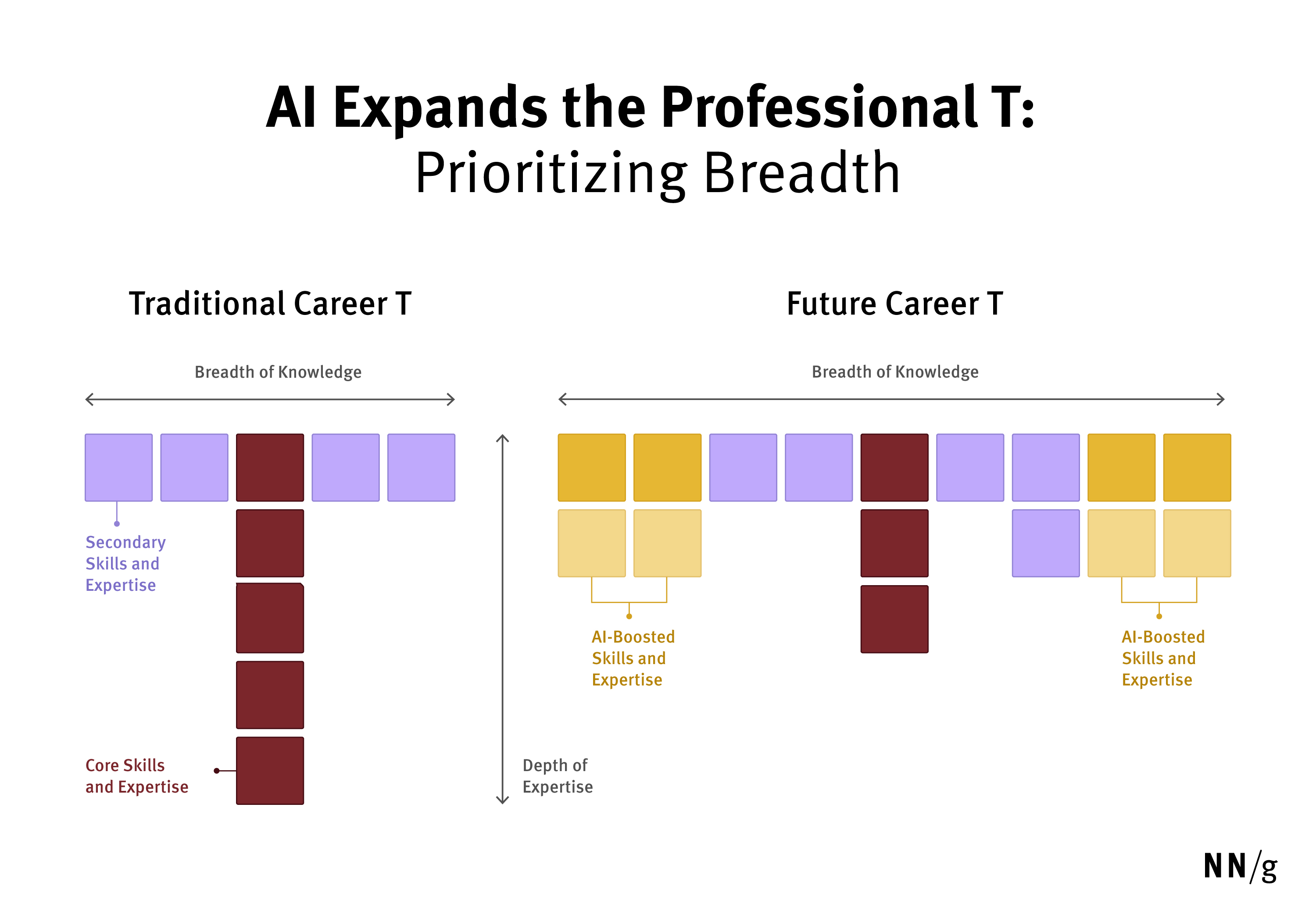
What we're seeing isn't the elimination of specialization but rather an increased value placed on expanding the top of a professional's "expertise T.”
- Broad knowledge across UX disciplines
- Systems understanding of how different aspects of UX work together
- Orchestration ability of solutions using various tools and approaches
- Strategic focus on high-level problem solving
Notice that the expertise T will also become shallower, as going really deep within a specialization will not benefit most people. Deep mastery will be the domain of academics investigating new knowledge or techniques, or large institutions addressing complex problems.
A New Role: The Experience Professional
We believe these broad skills will coalesce into experience designer and architect roles: people who direct AI-supported design tasks to craft experiences for humans and AI agents alike, while ensuring that the resulting work reflects well-researched, strategic thinking.
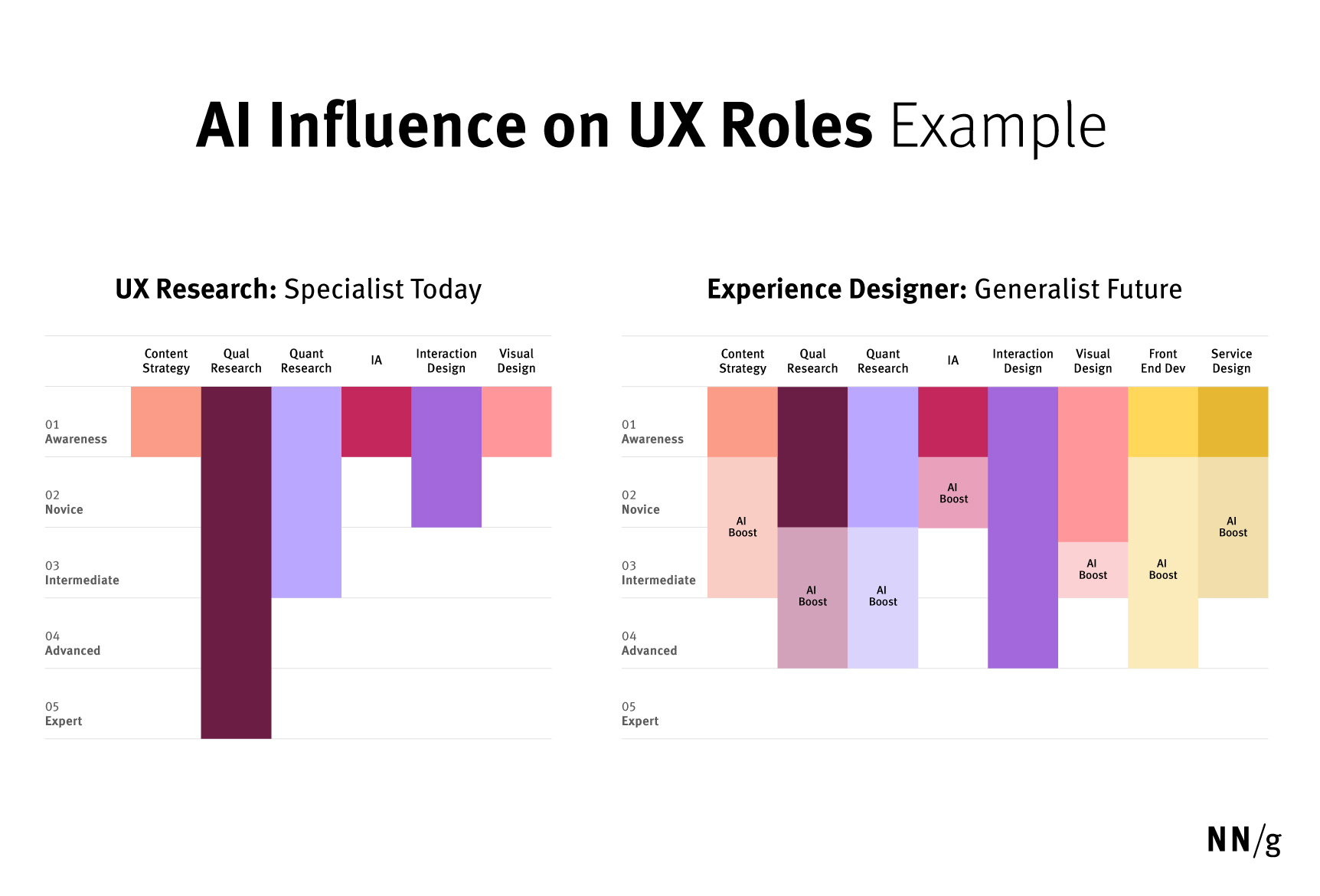
These generalist roles will not achieve perfection, or even the lofty heights of a well-trained specialist. Specialists will maintain advantages with lesser-known or advanced techniques. They will also be needed in mission-critical situations, where their expertise will help catch "invisible" problems that a generalist might overlook.
However, economic pressures will favor staffing strategies that are "cheap, fast, and good enough", despite the drawbacks. UX design is not like medicine or civil engineering. This broader generalist approach to design will rarely result in catastrophic outcomes. Therefore, companies will increasingly rely on AI-augmented generalists due to the strong business case for their efficiency, adaptability, and sufficient results.
We already see this trend emerging at leading AI companies. Anthropic, for instance, recently advertised a "design engineer" position that explicitly combines product management, design, and development responsibilities. This hybrid role requires professionals who can think across traditionally separate domains to create cohesive AI experiences.
This evolution reminds us of how the role of front-end developer (FED) emerged 15 years ago as a bridge between specialized backend development and design teams. What initially seemed like an unusual hybrid eventually became an industry standard, as the complexities of web interfaces demanded professionals who could navigate both technical and design considerations. Similarly, these new AI-focused generalist roles may begin as exceptions but could quickly become essential as organizations adapt to AI-driven design processes.
What Does It Mean to Be (More of) a Generalist?
A UX generalist isn't simply someone who dabbles in multiple disciplines. True generalist thinking involves a fundamentally different approach to understanding and solving problems. These professionals excel at recognizing patterns that span different areas of expertise and can often spot solutions that specialists might miss.
For example, a UX researcher working to become a UX generalist might:
- Notice how information-architecture principles from website navigation could improve the structure of a research report
- Pull storytelling techniques from content strategy to enhance the presentation of user-research findings
- Work with AI to develop mockups of potential design solutions for a problem identified in a recent study
This crosspollination of ideas leads to innovative solutions that transcend traditional disciplinary boundaries.
This approach isn't entirely new — many veterans who entered the field 20+ years ago started as generalists out of necessity. In the early days of UX, professionals often wore multiple hats by default, handling everything — from research to design to usability testing. These seasoned practitioners have long understood the value of crossdisciplinary thinking.
However, for those who joined the industry during the past decade (a period of increasing specialization and role definition), this shift toward generalist skills may represent an adjustment. Many newer practitioners have developed their careers within narrowly defined roles, focusing deeply on specific methodologies or deliverables. For these professionals, expanding into a generalist mindset might require intentional effort to broaden their perspective and get comfortable working across traditional boundaries.
AI Accelerates Skill Development
Consider how a UX researcher might expand into visual design without the aid of genAI tools. This would require:
- Formal training or courses in design principles
- Years of practice and coaching to develop an intuitive sense of composition, hierarchy, and aesthetics
- Extensive trial and error to build technical skills
- Gradual accumulation of practical experience
AI tools won’t eliminate the benefits of these skill-development activities, but they will compress and enrich the learning journey by:
- Generating multiple design variations to help the researcher explore design patterns
- Explaining design decisions and principles in context
- Providing immediate feedback on design choices
While today’s AI tools can’t yet perform all these functions with the quality of an experienced professional, they help accelerate pattern recognition and decision making by exposing the researcher to more iterations along with guidance written to maximize the researcher’s comprehension. The ability to orchestrate many small design decisions toward a broader vision will still require human judgment, but AI lowers the barrier to developing this expertise.
This skill-development acceleration isn’t limited to visual design. Content strategists will be able to grasp information architecture faster by having AI analyze site structures. Visual designers could efficiently experiment with research methodologies using AI to develop interview guides, or aid in thematically analyzing interview data. AI tools won’t replace the need to understand fundamental principles, but they will shorten the time to internalize and apply them effectively.
Learning UX Fundamentals to Unlock AI’s Advantages
Leveraging AI will require UX professionals to build a solid foundation the UX discipline and in UX-adjacent areas. Without these fundamentals, practitioners will lack the conceptual awareness needed to provide robust guidance to AI tools, leading to inefficient or suboptimal outcomes. A well-rounded UX background will equip professionals with the critical thinking skills, contextual judgment, and the vocabulary needed to fluently collaborate with AI.
Technical Execution to Strategic Activities
As AI systems continue to advance, they're becoming increasingly proficient at handling technical-execution tasks that once required specialized human expertise. Soon, these tools will generate wireframes, create user flows, produce visual designs, and analyze research data with minimal guidance.
This evolution means that the unique value we bring as UX professionals is shifting decidedly toward strategic thinking and leadership. While AI can execute tasks, it cannot independently understand the complex human and organizational contexts in which our work exists.
For example, instead of spending time learning or doing the technical tasks associated with their roles, practitioners will focus on more valuable activities like:
- Facilitating conversations between stakeholders with competing priorities
- Coordinating crossfunctional teams and navigating organizational dynamics
- Developing nuanced understanding of business constraints and opportunities
- Building relationships and buy-in with decisionmakers
- Identifying and fixing crosschannel journey-experience problems
This shift toward strategic thinking will transform how we develop professional expertise. Rather than spending years building deep technical expertise in a single area, professionals will quickly develop working knowledge across multiple disciplines and then build experience in strategic activities.
It’s Already Happening: Industry Example
A recent shift at Landor, a global brand-transformation company, illustrates this trend toward generalization in real time. At a recent research-leads dinner, Anthony Riva, executive director at Landor, shared how the company has expanded its job roles to embrace a generalist approach.
Landor’s original job description for an Insights & Analytics Director emphasized specialized research skills, focusing on traditional qualitative techniques, proprietary market-research study design, and specialized analytics methodologies. The role centered on supporting existing frameworks within a clearly delineated insights function, primarily focused on research execution and data synthesis.
In contrast, the newer Director, Brand Performance position exemplifies the generalist evolution we're discussing. This role transcends traditional research boundaries by requiring expertise that spans data analysis, business consulting, financial modeling, and brand strategy. Rather than merely collecting and analyzing data, this position demands the ability to connect and analyze disparate data sources to generate actionable insights that can impact clients and the commercial impact of brands."
The new role description reflects a significant shift toward strategic thinking and crossdisciplinary skills, calling for collaboration across strategy, design, and client-services teams. It specifically requires an understanding of how brand contributes to business success — a clear indication of the broader perspective now expected. Where the previous role emphasized technical research execution within a specialized function, the new position demands business acumen and the ability to translate brand initiatives into commercial metrics and financial outcomes.
This evolution at Landor is an example of how the industry is responding to changing market demands. Organizations will increasingly seek professionals who can bridge multiple disciplines and connect brand work directly to business impact . We suspect we'll continue to see this expansion of roles, which will lead to new titles, that will then slowly funnel down into education and academic programs.
Preparing for the Transition
To adapt to this shift toward generalist skills, UX professionals should focus on 4 key areas:
- Developing a learning mindset
- Becoming fluent in AI collaboration
- Focusing on transferable skills
- Expanding into adjacent fields
Develop a Learning Mindset
Instead of investing time solely in deepening expertise in one area, prioritize expanding your understanding across experience disciplines by seeking opportunities to collaborate with practitioners from various specialties.
This approach is crucial if you're new to the industry. Early-career professionals should be cautious about taking positions where they're the only UX practitioner. Without more experienced colleagues to learn from, your growth will be significantly slower.
Figuring out how to learn from your experiences, both successes and failures, is how you will grow beyond your current UX-job duties and be prepared for the future.
Become Fluent in AI Collaboration
To leverage AI, the UX generalist will need to be comfortable working with AI to get their desired results. While the unusual “prompt engineering” tricks and formatting of today will eventually give way to more-natural approaches, building hands-on experience now will provide a deep understanding of AI’s capabilities and limitations. It will also provide valuable experience with articulating one’s intent, which will provide an advantage over those just beginning to adapt.
Focus on Transferable Skills
As we’ve discussed, there will be a high value placed on strategic-oriented talents that remain valid regardless of how tools and technologies evolve.
These forever skills include:
- Critical thinking
- Facilitation
- Strategic decision making
- Intuition spanning multiple domains
- Navigating ambiguity and rapid change
- Expertise in combining insights from diverse sources
- Skills in reframing problems to uncover new solutions
These skills cannot be replaced by technology and will become increasingly important as AI handles more technical tasks.
Expand into Adjacent Fields
As the boundaries between disciplines blur, understanding related areas becomes crucial. If these aren’t your talents yet, it’s time to start developing them.
- System thinking
- Front-end development and data modeling
- Business strategy
- Product management
A broader perspective not only improves collaboration but also prepares you for emerging roles that combine multiple disciplines.
Finding Balance in the Future
This shift doesn't mean specialists will disappear — there will always be room for deep expertise in specific areas. Government and complex-enterprise UX will continue to have the scale and complexity that will benefit from a specialist’s skillset. Large, highly UX-mature organizations will also continue to benefit from domain mastery and specialist roles may be reserved for highly advanced practitioners at elite institutions. Competition for these roles will be fierce.
In addition, AI-enhanced tools for UX work are still developing. In their current form today, these tools are not yet reliable or robust enough to substantially boost a generalist with no skill proficiency into a viable replacement for a mid-level specialist. We are still in the early days of realizing the potential of generative and agentic AI technology.
However, for many UX professionals, embracing the role of a generalist (or even just slightly broadening the scope of their skills) will become increasingly valuable. There will be far more job opportunities for generalists, as the numerous low-UX-maturity companies will realize they need some UX support to survive among competitors leveraging the benefits of UX.
As AI continues to evolve and handle more complex tasks, the ability to see connections, think strategically, and coordinate across disciplines will become even more crucial. The UX generalist of the future isn't a unicorn trying to master everything, but rather a strategic thinker who can effectively leverage both human expertise and AI capabilities to create exceptional user experiences.