
Like it or not, there’s both an art and science to learning how to write a cold email template that predictably converts new freelance clients.
Today, we’re talking about both. And we’re using my real cold email templates, case study examples and screenshots of the actual cold emails that generated $110,500+ for my own freelance side business last year. You can pick up all of my free cold email templates for freelancers right here.
However, as much as I’d like to tell you there’s an easy-to-follow, clear copy & paste formula for writing a cold email that lands you new business every single time, the reality just isn’t that simple. That being said, it is incredibly helpful if you’re starting with a cold email template and pitching process that’s been perfected over five years and through hundreds of freelance pitches in the real world.
Free Download: High-Converting Cold Email Templates for Freelancers
Disclosure: Please note that some of the links below are affiliate links and at no additional cost to you, I’ll earn a commission. Know that I only recommend products and services I’ve personally used and stand behind. When you use one of my affiliate links, the company compensates me, which helps me run this blog and keep all of my in-depth content free of charge for readers (like you).
In this post, I’m going to show you real cold emails that have led to life-changing deals for my freelance content marketing business (and helped me launch into freelancing full-time in 2016).
Perfecting my cold email outreach process has done a lot for my freelance business—which is primarily based around writing and promoting high quality blog content for my clients.
- One of the cold emails we’re examining converted into a $52,500 deal for 2 posts per month, that’s continued for ten months.
- Another has translated into a $17,500 contract for 7 blog posts so far.
- And the last one we’re diving into landed me a $10,000/mo retainer contract for 4 posts per month.
These cold email templates we’re looking at today have generated me a total of $110,500 in 2018 alone.
This process for writing cold emails has generated multiple six-figure freelance contracts and high-value gigs for me with companies like LinkedIn, Zendesk, Quickbooks, Adobe, Vistaprint, Close and more. Since then, I’ve joined Close as their Head of Content where we share high-impact cold email templates for sales teams too. We also built this awesome free AI-powered cold email generator tool to help you quickly write better cold emails.
Here’s the truth about freelancing though: Success is never guaranteed.
And you can’t compare where you are in your freelancing journey today with where others are right now. I’ll be the first to tell you it’s taken me plenty of time to get to where I am today. And trust me, I still get pitches rejected plenty.
There will be great times when you’re overflowing with work and turning away new clients right & left. Yet still, there will be other times when you’re tempted to take anything that comes your way—or you’re spending most of your days doing outreach to drum up new projects.
In my experience, it takes a lot of hard work and hustle to hit the six-figure mark as a freelancer. Especially if you’re risk averse like me—and want to get there before you quit your day job.
If you’re not careful, it’s easy to slip into a cycle of feast or famine. But having a high-converting cold email template and process for pitching new clients can help you stay busy—with the right kind of clients—year round.
As you do great work for your clients, start getting referrals and build a brand for yourself within your niche, you’ll be able to step further and further away from spending large blocks of time regularly cold emailing & pitching new clients.
Good clients and solid projects will begin coming to you.
For now, let’s talk about cold emailing and dig into the cold email templates I’ve battle-tested and tweaked for years. That’s why you’re here right?
5 Steps to Write Cold Email Templates That Convert
We’re going to cover both components of learning how to write a cold email that converts—the art and science.
First, the art.
The Art of Writing a Cold Email That Converts.
Not even the best cold email will get you a response if you’re pitching the wrong type of client or a point of contact who’s not empowered to take action on hiring you.
Context is everything when you’re pitching new freelance clients—especially with a cold email.
1. Identifying the Right Clients.
If the majority of your experience is in writing about finance or real estate, it doesn’t make much sense for you to pitch a company in the healthcare space on your freelance writing services.
Same thing goes for designers. If your style favors flat design, motivational quotes about hustling, and retro color schemes, you’re probably not going to enjoy working with stuffy, well-established brands that have no plans to move their branding into the 21st century.
Choose only to approach clients that you could picture yourself working with.
If you don’t resonate with their brand, style and tone, leave it be. You’ll be able to deliver better work elsewhere. And they’ll also benefit more from hiring someone else.
Just as important as picking the right client for you to pitch, is making sure that you’re also right for them.
Not enough freelancers think about this.
But even when you are considering it, that can still be pretty difficult to judge, right?
Answer these questions when considering a prospect to make sure this is the right client for you (and that you’ll be good for them):
- What makes you uniquely qualified to help this particular client?
- Have you done similar work in the past?
- Does the prospect of working with this client excite you, or it purely a financial decision?
For my freelance content marketing business, I very thoughtfully brand myself in a way that makes me appealing to a certain type of client.
I’m not a marketing consultant to just anyone that’ll hire me. I’ve leaned into my experience over the years, developed my own marketing tactics and have come up with a very specific set of clients I’m uniquely qualified to help—where my services get supercharged.
That’s meant branding myself specifically as a content marketing consultant, a small niche within the broader marketing world.
On top of that, I work only with business experts and growing startups where I’ll be able to write about topics related to business, freelancing, productivity and entrepreneurship (what I already do here and original motivation for starting a blog, and what I’ve done for years). It’s only recently that I’ve learned how to make money blogging through passive sources that don’t require as much freelance work.
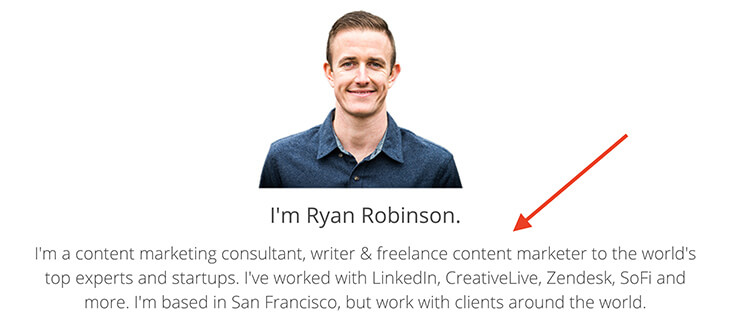
I also clearly highlight clients I’ve worked with—to encourage more of the same to want to work with me: Tech startups in San Francisco.
For many reasons, picking a niche is one of the best decisions you can ever make as a freelancer.
Here’s the logic behind picking a niche.
Let’s say you own a coffee shop and you’re looking to hire someone to help you with a rebrand, coming up with new visuals, a fresh logo and marketing materials… and you’re choosing between 2 different options for freelancers who say they can help you.
Freelancer #1 is a generalist. She’s got a broad range of experience running marketing campaigns, knows how to use Adobe Photoshop & Illustrator, has made a few logos over the year and does the design work for her personal website—mostly for fun, but you like her style.
Freelancer #2 is a specialist (with a clear niche). He works for himself as a full-time graphic designer and has done branding work for several coffee shops over the years. You like his style just as much, and can tell that he’s got a lot of experience doing exactly the kind of work you need done too.
Which freelancer would you choose?
Every day of the week, I’d take freelancer #2. The specialist.
I’ll also pay them significantly more—because I know I’m tapping into expertise.
In your freelance business, you want to brand yourself as that expert with a niche. Make yourself the obvious choice. That’s step one for making sure your cold emails get answered.
Now, you’re ready to start searching for freelance clients.
Start with the people you know first.
As much as I love cold emails, warm introductions are significantly more effective, so begin there.
Look first to these groups of people within your network to determine if there are any freelance opportunities to work with those who already know your work ethic, are personally invested in their relationship with you and want to see you succeed:
- Friends (and their friends)
- Family (and their friends)
- Previous co-workers who now work elsewhere
- Classmates from school
Regardless of the exact role your connection has within the company they’re at, if that company could be a good fit for you to pitch on freelance work—that’s a great opportunity to chase down.
Pick up the phone to catch up, grab coffee and ask if they’d be willing to introduce you to the right person within their organization for chatting about helping out on a freelance basis.
At the very least, walk away from these conversations with the name for who you should be reaching out to—then you can work your cold email magic.
Once you’ve exhausted your network, check out these high quality freelance job sites.

Personally, I never advise freelancers to set up shop on the big sites like Upwork or Freelancer.
Sure, you can find success stories of freelancers who make six-figures on their platforms (usually promoted by those companies), but that’s the extreme exception. Compared to the number of freelancers you’ll be competing on price with, next to nobody is making a livable (in the U.S.) wage there.
The reality is that most people looking for freelance help on these sites are really shitty clients to work for.
It’s the fast track to being treated like a commodity.
You’re here because you want to land higher paying gigs—not $25 to come up with blog post ideas and write them… or $10 for new logo designs.
While I believe it’s generally ok to do inexpensive (or free) work in the very early days to build up some experience and a portfolio, you should start charging as quickly as possible. It also needs to be sustainable pricing from day one, then as you grow you can continue increasing your pricing.
You’re worth more than a $25 blog post or $10 logo design, and you should be charging for the value you deliver.
So, which websites are good for finding high quality freelance clients that’ll pay you what you deserve? Start with these options:
- These 78 Freelance Job Sites to Land High-Paying Gigs
- My picks for the 60 Best Websites to Find Remote Jobs This Year
- If you’re a writer, try these 36 Blogging Jobs Sites
- My list of 55 Work From Home Job Sites to browse this weekend
- Angel List
- Toptal
- Coroflot (designers)
- Authentic Jobs
- Indeed
- Hacker News
As you’re sifting through opportunities, I recommend creating a Google Spreadsheet to add & keep track of interesting postings. Continue updating the status of your blogger outreach efforts so you’re able to see how well your cold email outreach performs over time.
Important: Before applying to any of these opportunities directly through the job posting websites, PLEASE pause right here. If you click that apply button and upload your LinkedIn profile, you just become another drop in the bucket—that’s not how you get noticed.
Let’s talk about getting your cold email right in front of the decision-maker.
2. Finding Your Ideal Point of Contact.

When I’m trying to land a new freelance client, I don’t want to spend time convincing a gatekeeper on the company’s HR or recruiting team that I’d be the best for the job—I’m going straight to the person who’s going to be in control of the hiring decision.
Sure, the HR gatekeepers probably have criteria they know to look for, but that leaves too much up to chance.
I want to cold email pitch someone who speaks my language.
As a content marketer (or freelance writer), my ideal point of contact at a potential client company usually has one of these job titles:
- Director of Content Marketing
- Content Marketing Lead
- Senior Content Marketing Manager
- Director of Marketing
- Blog Manager/Editor
- VP of Content Marketing
You want to go for a manager-level point of contact. The type of person who will have a say in hiring contractors for your discipline.
If you’re a freelance designer, you’ll probably be looking to connect with a creative director. If you’re a freelance developer, your ideal point of contact will likely be a director of engineering.
Sometimes, if you can’t find a manager point of contact, making an initial (genuine) connection with someone who’s a staff writer—or designer, engineer—can lead to an introduction up the chain to their manager if you’re able to provide a significant amount of value in your cold email outreach.
What’s important is that you skip the application, and go for connecting directly with real people.
Using LinkedIn to find your ideal point of contact.
Open up a new tab and head over to LinkedIn.
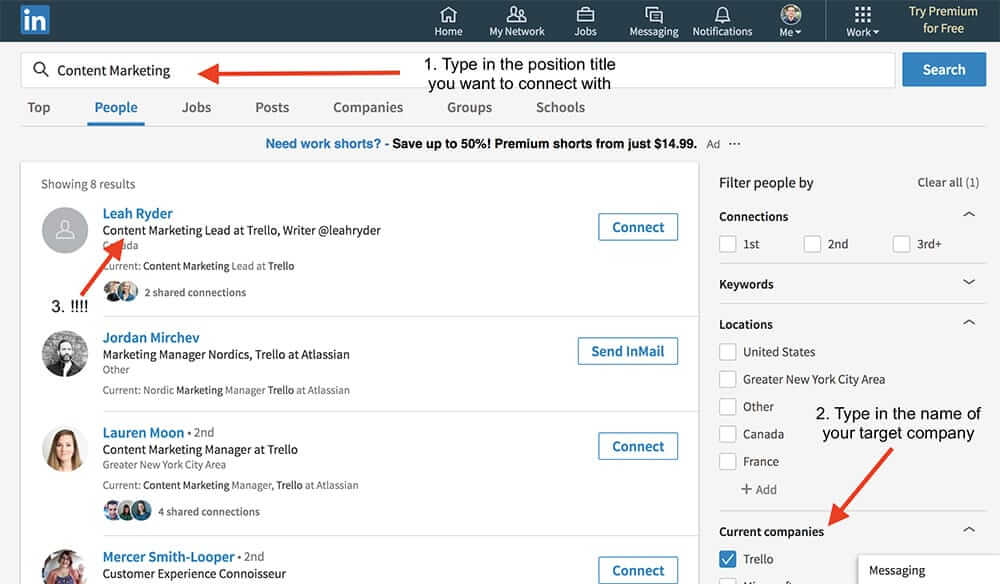
In the main search bar, type in the title of the position you want to connect with—choose to display results for people with that job title or skill.
Then, you can filter those results by people only with that job or skill at the company you’re targeting, by typing in that company’s name within the current company field. Now, your results will be hyper-specific.
If I want to land Trello as a content marketing client, my search would look like this:
Naturally, this works best for companies within a certain size range.
If they’re on the smaller side, you might not immediately find a very clear point of contact. Same goes for enterprise-size companies that have dozens of potential points of contact.
Make your best guess and keep moving rather than getting hung up or spending more than 5 minutes at this stage.
3. Getting Their Email Address.
Now that you have the name of your ideal point of contact, let’s get their email address.
Start by signing up for a free Hunter account—which in my experience is the best (free) tool for quickly finding accurate email addresses today. You’ll get 50 free searches each month, which is more than enough if you’re sending carefully curated cold email pitches and maintaining a high close rate.
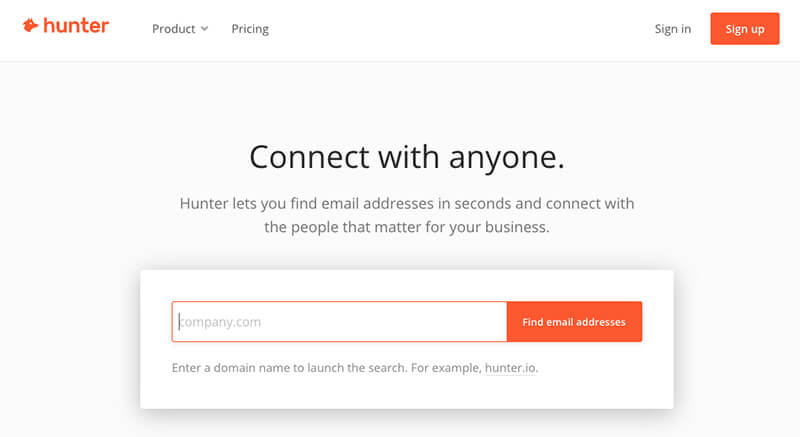
Once you type in the company website of the person you’re trying to send a cold email to, you’ll be presented with a list of everyone who’s email address is in the Hunter database at that company.
Filter the results by typing in the first and last name of your target prospect, and nine times out of ten, you’ll instantly get exactly who you’re looking for. Like so:
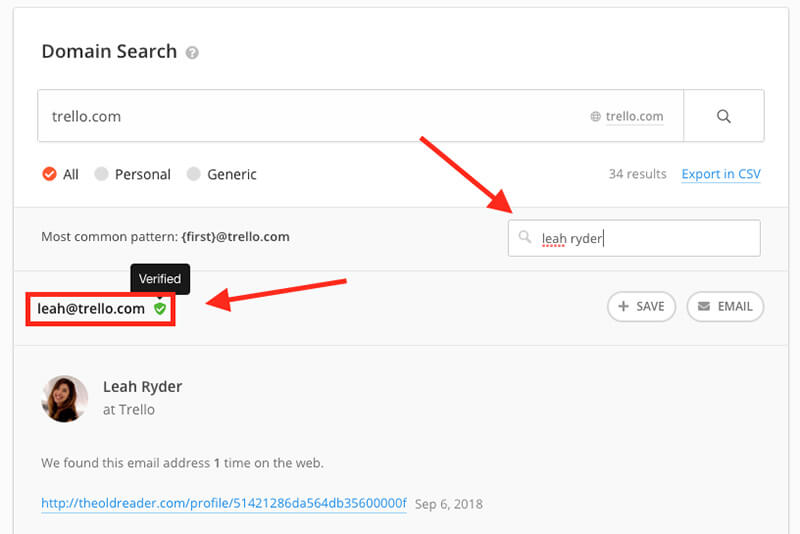
Even if your prospect isn’t 100% verified in the Hunter database, their tool will analyze the top email address formats in use at the company and give you a recommendation as to what the person’s email address most likely is—helping you move ahead with your cold email campaign.
In case Hunter doesn’t provide a clear result for you, these are the top five email address naming conventions most companies use today:
- first@company.com
- first.last@company.com
- firstlast@company.com
- firstinitiallastname@company.com
- firstlastinitial@company.com
In almost all scenarios, you’ll get your prospect’s email address in less than a minute of searching on Hunter or testing these formats. If Hunter doesn’t turn up any results for your search, I highly recommend trying one of these other top tools:
If you’re still unable to verify their email address with these tools, find them on Twitter to see if they have contact information (or chase a link to their personal blog that might have their contact info).
As a fallback method I use when these tools don’t populate much info, I’ll hover my cursor over their email address and see if they’ve connected a Google Plus account to the address. If they do, it’ll look like this right here:
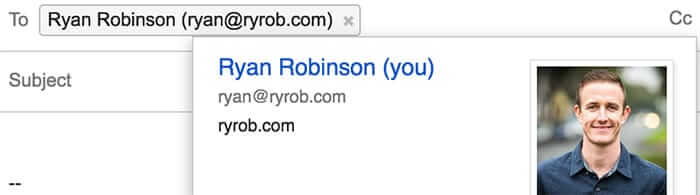
Once you have your target’s email address, you’re ready to move into writing your cold email and formulating a winning proposal for them. If you’re new to outreach, I recommend considering an email address without phone verification to use for safer outreach (without risking your own domain reputation).
Free Download: High-Converting Cold Email Templates for Freelancers
The Science of Writing a Cold Email Template That Converts.
Are you still with me?
So now that we’re on the same page, here’s where you need to be before you even get started on writing the actual cold email:
✔︎ I’m confident the company I’m reaching out to could use my freelance services (and it looks like they may need them now).
✔︎ I’ve tracked down the person who looks to be the right point of contact, a decision-maker on hiring freelancers in my department.
✔︎ I have their email address.
But before you go out and start cold emailing, you need to set sales goals for what exactly you hope to achieve with your cold outreach. Will you stop once you’ve landed your first client? The second? Fifth? Tenth?
Know how much work you can take on before overloading yourself.
Then, we can talk about what goes into the perfect cold email for landing a freelance client, starting with an example.
4. Choosing Your Cold Email Template & Outreach Approach.
First things first: As a freelancer, you need to use the tools you’ve got—and not make excuses for why you can’t land a particular client. If you go above and beyond to wow a client you’ve really been wanting to work with, you can make it happen. It’s in your power.
For me, long before I ever became a contributor on sites like Forbes, Entrepreneur and Business Insider that have since helped me boost my visibility, I was using my blog as my most powerful asset for leveraging freelance gigs. I put my marketing skills to use in a way that I could showcase them as real portfolio examples across the Internet in the format of blog posts, online blogging courses, writing eBooks, publishing my own blogging books and otherwise.
When it comes to nailing your outreach emails, don’t sleep on the importance of investing in writing a simple, straightforward, and appealing subject line. Try out this free email subject line generator tool and get dozens of ideas in seconds.
Cold Email Template #1: “Your Feature on My Blog”.
This first cold email template—specifically crafted for business influencers and startup founders—is built around using my blog as a way to provide value before I ask for anything in return.
Here’s how the process works:
- Ask for a quote to include in an upcoming article they’d want to weigh in on.
- Publish my blog post with their quote (), promote it heavily and drive them traffic.
- Reach back out to update & thank them for contributing to the post.
- Highlight early success in that email (# social shares, traffic, any features on publications)
At this point, some will outright ask me if I can help them create content like this for their blogs—often because my blog headlines will resonate with their readers too. Others I’ll need to then pitch on my content marketing services (like putting together a content marketing strategy & executing on it) if they don’t bring it up themselves.
It’s not always a good fit for everyone I ask, but because I’ve already provided value AND essentially given them a real-time demo of what my service is through the post they’re included in, my conversion rate to paid client relationship with this method is extremely high.
This cold email template looks like this, with customizations made for each person I reach out to…
*Important* Don’t ever send straight up copy & pasted cold email templates to high-value potential clients. They know a cold email template when they see it (hint: I always do), and it’s worth your 3 minutes of research to make a more memorable impression.
And if you decide to use a tool that eventually automates & scales your cold email outreach, be sure to check out my personal favorites:
- lemlist: This cold emailing tool is unique in its ability to help you automate and personalize your emails at scale with their technology that allows you to insert & overlay custom screenshots, images or logos onto images within your emails—adding a much-needed personal touch without sacrificing the ability to send emails at scale.
- Woodpecker: This tool features a unique delivery process can help you send cold emails to an outreach list automatically, while appearing to arrive one at a time (as if you were sending them manually yourself).
Now, here’s my first cold email template:
…
Subject Line: Your feature on my blog
Body: Hey [First Name],
I’ve been a fan of what you’ve been doing with [Company Name] over the past couple of years.
I’m reaching out because I’m working on a new piece geared towards [topic of the blog post you’re writing] from those who’ve already been through this experience themselves and I’d love to hear your take on it. The post will be publishing to my blog [optional—that gets x # of readers] and I’d love to get a quick quote from you to include in the piece if you’re up for it.
If you’d be able to answer this question in a few sentences, that would be amazing:
[Relevant question/challenge that will give them an opportunity to showcase their expertise]? How do you advise people on overcoming that challenge?
[Your Name]
…
No promotional links.
No service pitches.
No asking if they’re hiring.
You need to be patient at this stage. Your goal is to provide value and show your worth.
By doing that first, instead of just making promises of the value you could deliver in the future, you’re going to win their trust and catch their attention in a much different way than 99% of other freelancers cold emailing and pitching them to be hired.
Seems simple, but almost nobody has the patience to execute this kind of in-depth sales strategy. And because of that, so many freelancers waste a lot of time writing cold emails that get no response, largely because they’re being too shortsighted.
Sure it can take weeks to turn into a paid gig—and sometimes it never will—but the freelancers who take my course on learning how to pitch effectively, experience massively positive results from following this strategy.
…
Here’s a screenshot of this cold email tactic in action last year (name and details blurred for privacy).
This is the one that netted me a $50,000 deal:
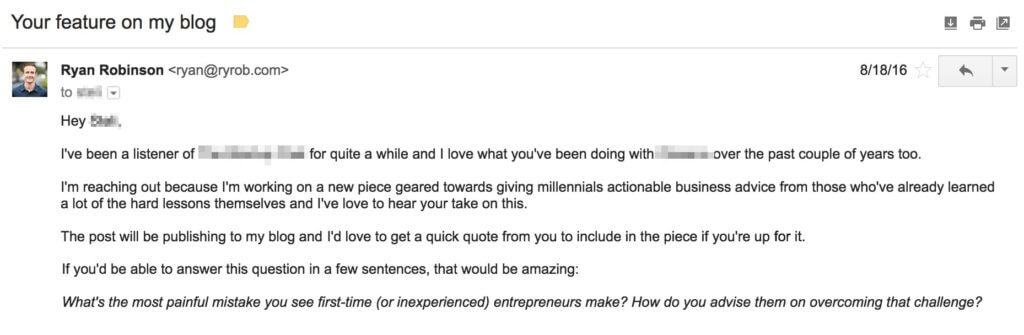
After getting the quote from this startup founder and including him in my post, he was pumped about the thousands of shares the post had received in the first few weeks of going live (I spent $100 boosting the post on Facebook, Twitter, Pinterest & Quuu Promote to get an initial share spike).
This founder wanted those kinds of results for his startup’s blog too.
He actually beat me to the pitch—and emailed asking if I’d be up for working with him:

After a quick chat on the phone laying out my workflow and getting clear on his goals, we locked in a strategy for publishing 2 posts each month—we’ve been working together since.
Cold Email Template #2: The “Referral” Warm Up.
What’s better than sending a cold email? Well… sending a warm one.
Compared to the first cold email template we talked about, this warm introduction strategy typically converts much quicker.
It’s straight to the point and doesn’t rely on needing to first get a quote, publish a blog post, or otherwise.
I use it when I’m approaching a company that’s a bit larger and doesn’t have a clear figurehead that’d be reasonable for me to be able to connect with individually by shooting her/him an email.