What is Web 3.0 (Web3)? Definition, guide and history
What if the web could conjure up exactly the information you needed in exactly the format you wanted -- before you knew enough to ask for it?
It would certainly be a much different, maybe even desirable -- if a little creepy -- internet experience. Yet it could someday be the reality of Web 3.0, the next version of the web.
Thanks to the changes that proponents of Web 3.0 claim it will bring, the internet will be much smarter, because artificial intelligence will be ubiquitous. All the world's data will be unified in a so-called Semantic Web. Everyday users will have more say than wealthy corporations about how their personal information is used. Banks will be irrelevant as people exchange digital currencies and records without intermediaries.
Whether Web 3.0 comes to pass, especially in the form currently envisioned, remains an open question. What's clear is that interest in Web 3.0 has never been higher. Enterprises are ready to learn enough about Web 3.0 to decide what actions to take, if any.
This guide provides answers to common questions and has hyperlinks to articles that go into depth about the business opportunities and risks. It also has detailed explanations of key Web 3.0 concepts, such as the effects of decentralization on web governance and data management, and what enterprises can do today to test the Web 3.0 waters.
What is Web 3.0 (Web3)?
Web 3.0 describes the next evolution of the World Wide Web, the user interface that provides access to documents, applications and multimedia on the internet.
Web 3.0 is still being developed, so there isn't a universally accepted definition. Even the proper spelling isn't nailed down, with analyst firms like Forrester, Gartner and IDC toggling between "Web3" and "Web 3.0."
What is clear, though, is that Web 3.0 will place a strong emphasis on decentralized applications and probably make extensive use of blockchain-based technologies. It will also use machine learning and AI to empower a more intelligent and adaptive web.
Evolution of the web
If it comes to pass, Web 3.0 will be the successor to two previous generations of the web.
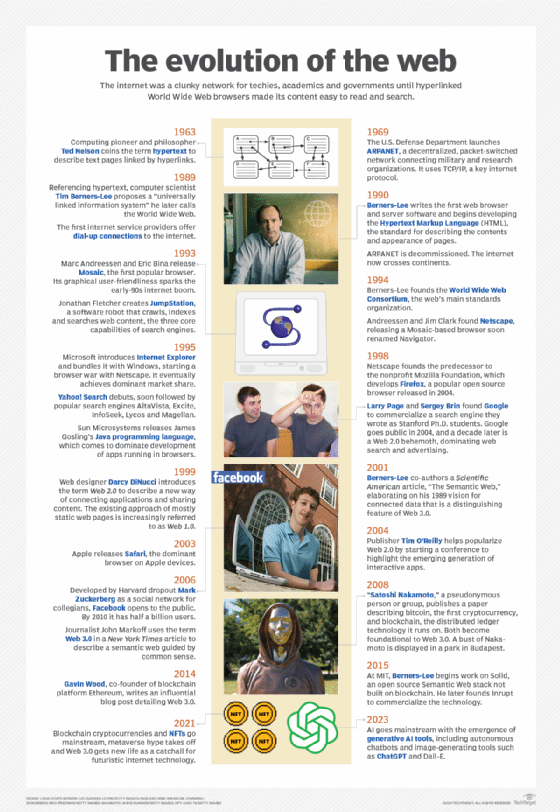
The first generation, referred to as Web 1.0, was invented in 1989 by Tim Berners-Lee, a British computer scientist who applied the hypertext concepts for linking digital text proposed in 1963 by Ted Nelson, an American information technology pioneer. Besides programming the first browser, Berners-Lee wrote the Hypertext Markup Language (HTML), which tells browsers how to display content, as well as the Hypertext Transfer Protocol (HTTP) specifying how web servers transfer files to browsers. He also started designing software for a "Semantic Web" that would link data across web pages, but hardware constraints prevented its implementation.
The public was not much aware of the web until 1993 with the release of Mosaic, the first popular browser, later renamed Netscape Navigator. Similar user-friendly graphical browsers followed, including Microsoft Internet Explorer and, much later, Apple Safari. The first popular search engines -- familiar names like Yahoo! Search, Lycos and AltaVista -- arrived on the scene, but by 2004 Google had put many of them out of business.
Around the turn of the millennium, experts began promoting the idea of an upgraded web that would be more interactive, calling it Web 2.0. They started referring to the existing web of basic connectivity to mostly static websites as Web 1.0. Berners-Lee fleshed out his Semantic Web concept by co-authoring an article in Scientific American. Publisher Tim O'Reilly helped promote Web 2.0 by starting a conference dedicated to it.
The dream of an interactive web came to fruition several years later with the skyrocketing popularity of social networks like Facebook. The World Wide Web Consortium, the web's standards body, released a Semantic Web standard. Around the same time, two essential Web 3.0 technologies were born: cryptocurrency and blockchain. Prominent journalists and technologists, including Gavin Wood, co-founder of Ethereum, a prominent blockchain platform, began to popularize the terms Web 3.0 and Web 3 to signify a decentralized, semantically aware version of the web.